Counting Cormorants in Monterey
I had an hour sitting by the Monterey shore whilst my wife scratched for sea-glass, urchins and other debris. A group of gulls were nestled in partially submerged rocks, a family sat in deck chairs in way too windy weather and cormorant after cormorant went by. Some flew from "up" the coast against the wind (heading North-west) and some flew back "down" the coast the other way. Was there a difference between the heading of these birds? How many of them were there? Where are they going? I started counting and 1161 birds later built a story for the cormorants of this coast.
The birds moving up-coast numbered fewer, totaling 504 to the down-coasts 657. The cormorants loved moving in groups, only 5% of birds ever travelled on their own. Interestingly I saw twice as many single birds move up-coast than down-coast. As well as more single birds, the up-coast movers had smaller group sizes, averaging 5 birds per grouping, versus the down-coasts larger average size of 10. The down-coast path had the largest observed cormorant grouping of the hour containing about 40 birds. The cormorant traffic throughout the hour was lumpy. Many birds flew by in the first 30 minutes after which they stopped coming as much, before picking up again in the last 10 minutes. That much about the raw numbers where were they flying and what paths did the cormorants take?
This part of the Pacific Grove coast provides some interesting geography the birds have to navigate. Tucked just before the tip of land that marks the bottom "jaw" of Monterey bay, the coast here is less exposed than the shore around the corner. The immediate coastline was defined by a rocky outcrop that juts straight North out into the ocean, forming a knot in the shoreline birds could either swing around or cut across. There were two distinct paths depending on if the birds were moving up or down coast.
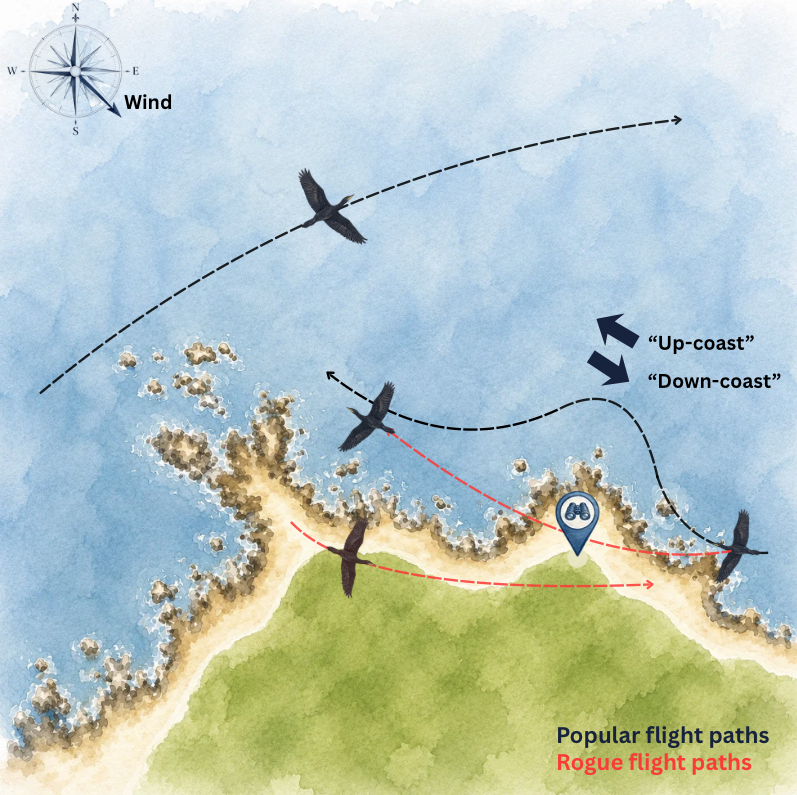
The up-coast moving group stayed close to shore, skirting along the coast and veering around the jutting rock outcrop before continuing on. They almost always stayed above the ocean. Being closer to shore presumably helped shelter them from the down-coast wind they were working against. The down-coast movers stayed much farther out. They came in from that exposed corner, and continued a trajectory taking them out to sea with the wind, deeper into the bay. So then, where are they going? The story I told myself was these birds were going out to sea to feed, and there's strength in numbers, hence the larger groups. A move out to sea to a well known feeding ground also dissuades single cormorants, why waste the energy and safety of moving in a flock?
Of all the birds I counted, only 4 ever came in land. These were always single cormorants that I like to think of as "rogues". Two of these rogues were left moving, and simply cut across the rock corner like a short-cut, before continuing on a standard left mover path. That at least saved them some distance. Another up-coast mover landed on a rock amongst the gulls and hung out for the remainder of the hour drying its wings. The final rogue was a right flying bird who flew so far in land I had to turn around! Almost flying over the road and houses of the shore. He was the only right moving bird I saw fly in land and on his own. The story I gave him was a real desperado of a cormorant, flying with abandon and lack of respect for the averages and patterns I had been noticing.
Two lists of numbers and a few hand drawn maps allowed us to quantify and speculate on the behavior of birds. We found up-coast movers, down-coast movers, rogues and desperados. Not the shells and marbled stones my wife found, but all the fun just the same.