Lessons from San Francisco Birding
When I moved from San Jose to San Francisco I wondered whether my birding life would move with me. I had built up a number of encounters over the years, living close to the salt marshes, Ulistac Natural Area and the dry hills of the East Bay. Birding occurred through deliberate outings and fortuitous encounters in day-to-day life. The picture I had of SF before moving was a dense urban jungle, punctuated by occasional greens spaces of Golden Gate Park, the Presidio and Sutro Baths. Even so, I was nervous as to what awaited me. As it turned out, the city had many lessons to teach about birding.
Great-Horned Owls - "Common birds"
I used to hear the cooing of birds perched on our home in the early evening. As a kid, I attributed this hooting noise to owls, and was always disappointed to learn they were pigeons. Fast forward 25 years and I still had never seen an owl. In fact, I'd never even heard one hoot. A change of country from England to United States didn't seem to help either, despite the field guides broad swathe of purple telling me Great-Horned Owls are common across the country.
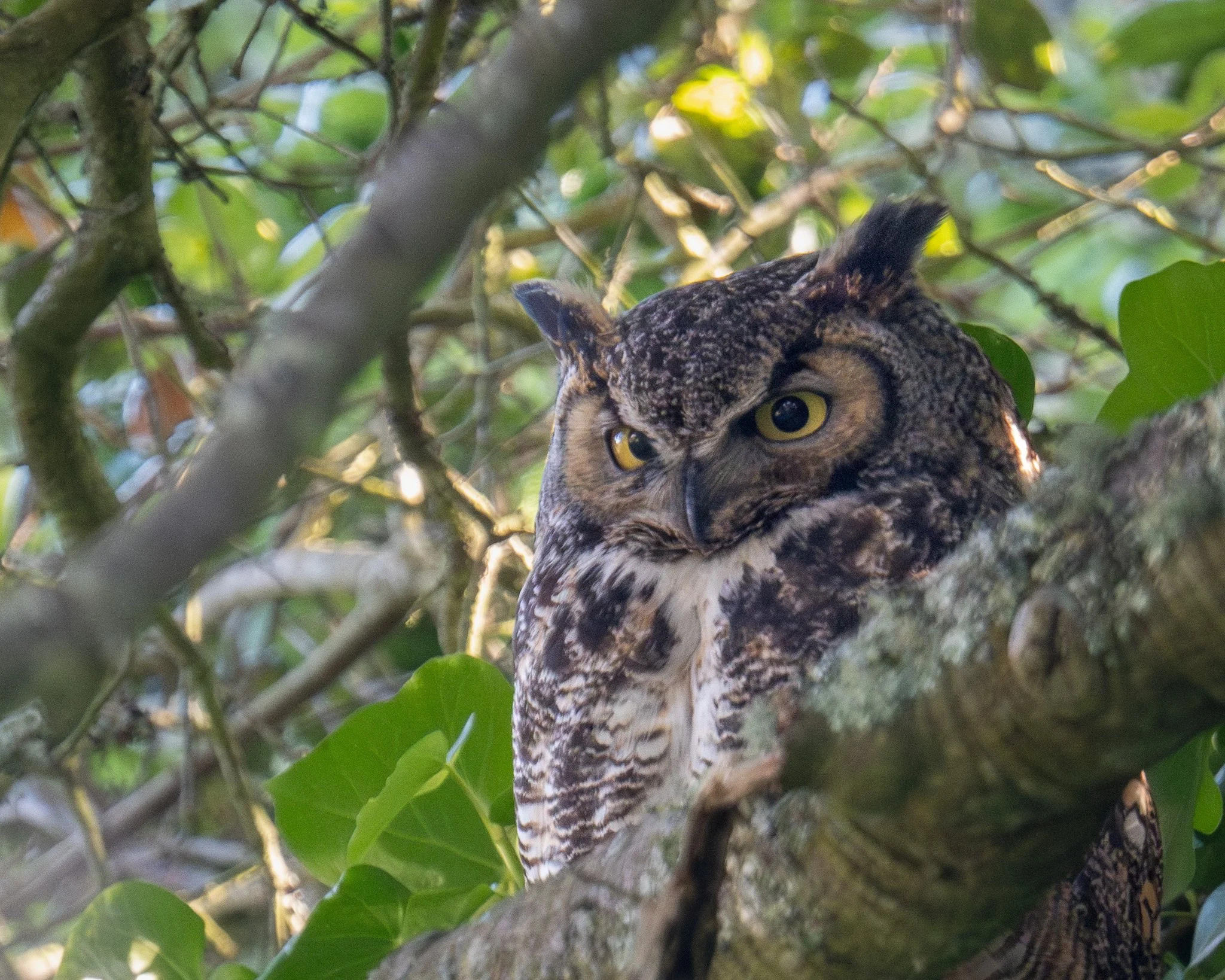
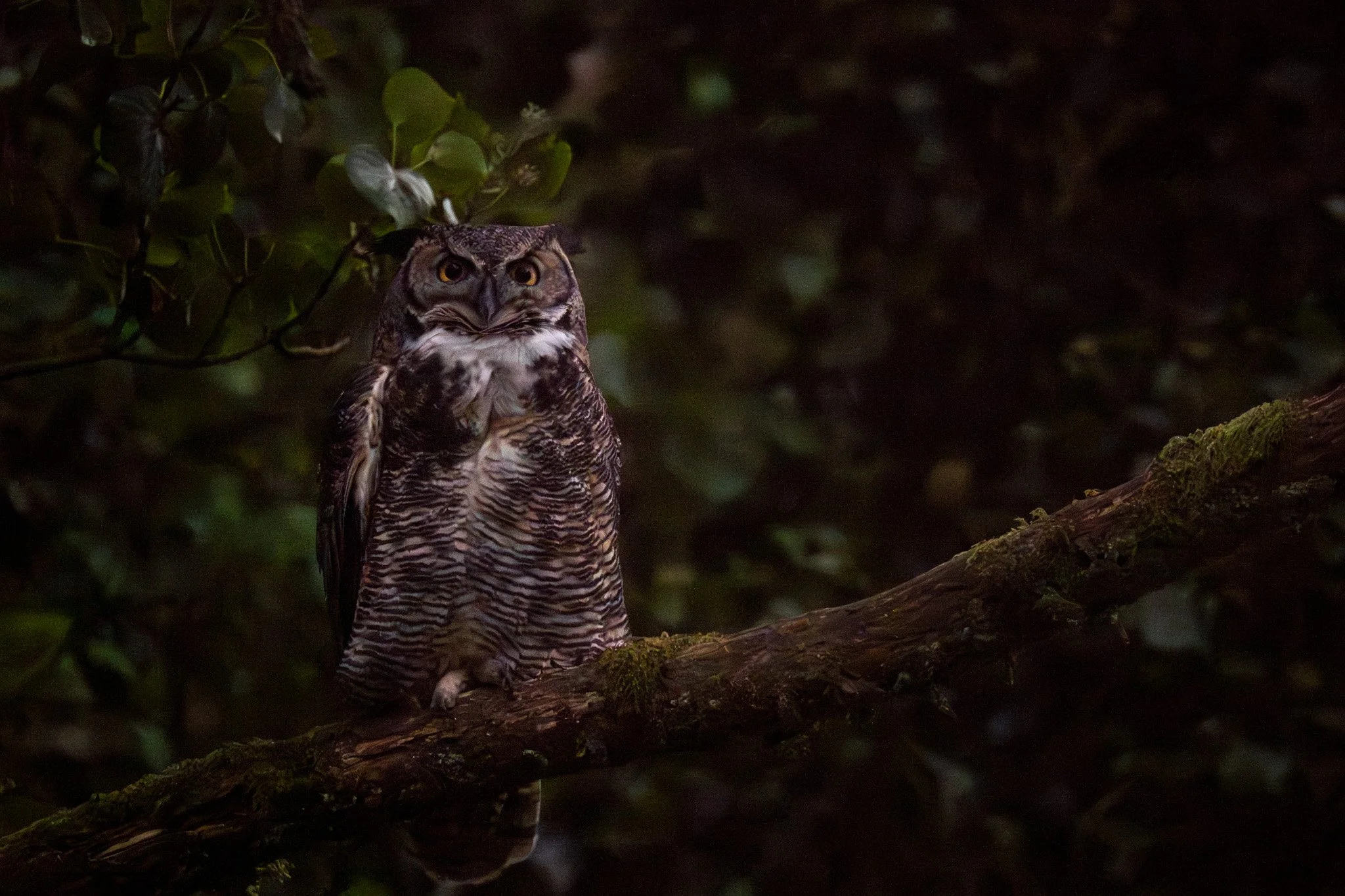
…hoot..hoot… we heard at home one night. A distant call whose rich bass burrowed through the noisy night. Must be a particularly baritone pigeon. We returned to our evening activities. HOOT…HOOT…a booming call rumbled through the windows. The source appeared much closer. Following the sound to the backyard, we scanned the steep slope and foliage that led up Twin Peaks. A grand bare tree stood in the sloping ground, and on a branch sat a Great-Horned Owl. It was huge! Much bigger than I was expecting, and perched in a tree in our yard.
The owl came and went over the course of the next few months. Sometimes we'd hear it distantly down the street, and oftentimes it would return to the same tree in the garden. Its calls are both a comfort and a menace, depending on the time it showed up. I stumbled upon more Great-Horned Owls throughout my time in SF. Loitering in dense shrubs of Glen Canyon, in soaring trees of Mount Davidson and around the slopes of Twin Peaks. I guess the guide was right after all, I just needed to be in SF.
Connecting book learnings to the field - Buteos and Accipiters
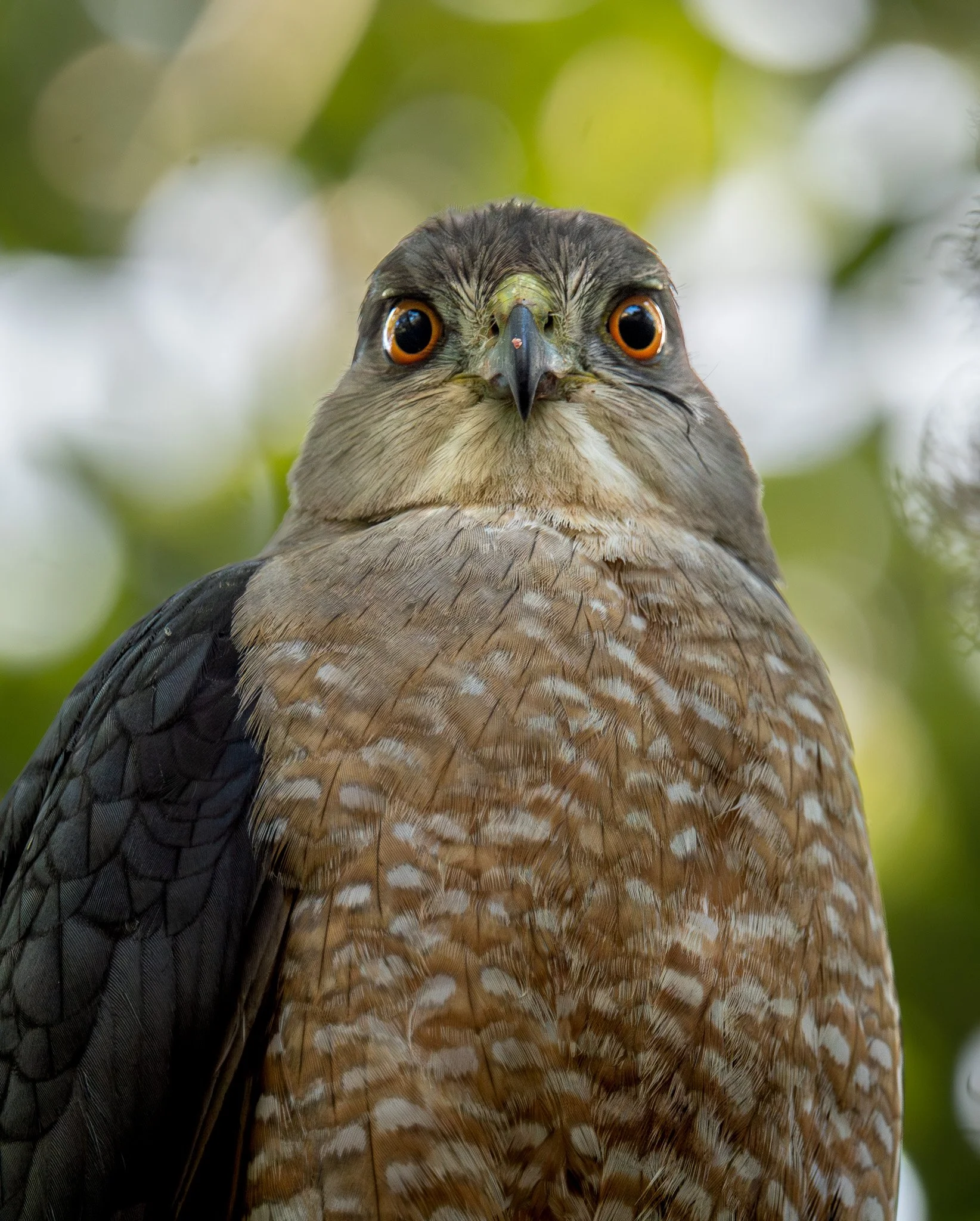
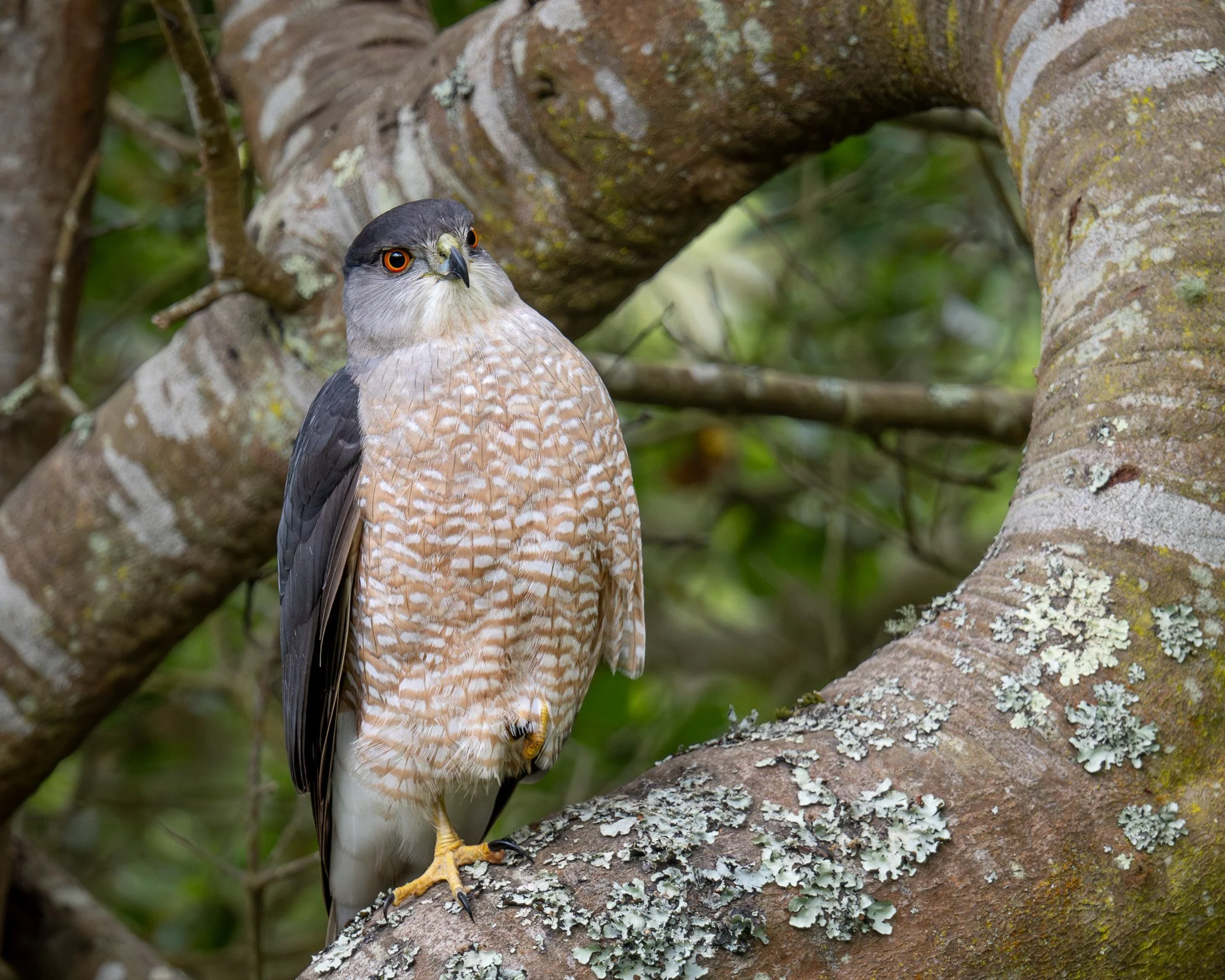
In a course on Raptors I'd heard about the difference in behavior between Buteo and Accipiter hawks. The Accipiter family (including the Sharp-shinned and Cooper's hawks) were well adapted to hunting in forests and tight spaces, whilst the Buteos (including Red-tailed hawks) took a soaring approach to flight. There were also significant size differences in the Accipiters, both between the sexes (with females dwarfing the males) and between species. I filed these facts away should anyone quiz me about hawks, but I admit I couldn't prove them to myself or tie it to any field experience. I'd only ever seen Cooper's hawks perched out in the open of San Jose's river creeks and bay flats. That seemed pretty similar behavior to the Buteos to my eye. These birds also seemed sizeable - showing none of the variation I had heard about.
The city turns out to be the perfect staging ground to demonstrate these differences. The urban sprawl offering an open sky high above buildings where Red-tailed hawks soar. From a vantage point up on Twin Peaks, we often saw 3-5 birds at a time dueling for air superiority and cruising above the dense jungle below. Closer to street level, the Accipiters were busy navigating the low hanging trees that lined the roads and trails of local green spaces. Acrobatically escaping from deep ravines with no more than 12ft of head height. Their displays were so impressive a Cooper's hawk even once stopped traffic after pinning a pigeon to the concrete road. As the spaces got tighter, the Accipiters slimmed down to match the niche. The miniscule Sharp-shinned hawk showed up in our yard one late Sunday afternoon. Emerging out of the sky between apartment buildings and steep hill to perch on the railing of our deck. They left as quickly as they came after surveying the scene and finding it up to code.
The blend and scale of habitats in SF was the perfect stage to exaggerate the differences between the Accipiters and Buteos. Concretizing the book knowledge I had "learnt" into a real connection between the bird families.
Birding without an ear
I thought I had a good handle on the style of urban birding SF presents: green pockets of Glen Canyon, the ocean-side habitats of Sutro Baths and micro-environment shrubbery of Union Square. Glen Canyon felt like an expedition into a lost gnarled forest, whose thick vegetation required intense staring to penetrate. By contrast, Union Square birding occurred in a series of stolen glances as events and colorful characters took the main stage.
I was surprised to find a patch that added a new angle to my urban birding, Alemany Farms. A little scrub of grassland, previously an unmaintained local garden, now rejuvenated to provide food for the community. And right next to I-280. The unique twist here? The noise. Now competing to hear bird calls and songs over the roar and rumble of the nearby 4-lane I felt cut off. How do I find birds without sound? A bolt of bright orange from tree to tree reminded me I have eyes too. The migrating Hooded Orioles a punch to wake up my visual sense.
Intense listening proceeded as I struggled to hear birds over the traffic. Song Sparrow calls in a nearby cattail marsh were audible - though took on a muddy quality. My ear adapted to pick out songs over the din, though there was a limit. For the majority of the birding I relied mostly on my eyes, or more accurately, 20 pairs of eyes. Birding in a group helped overcome the challenge of losing a sense, and we steadily racked up species throughout the morning. It was interesting to note the birds we could both see and hear versus those we only saw. A Mockingbird's song overpowered the rumble from the freeway, whilst the usually distinctive pips of the Black Phoebe were missing from its bobbing undulations.
SF's different birding opportunities, and especially Alemany Farms, introduced how different birding can feel when our approach changes. It's inflamed my imagination to tackle birding in various ways - no binoculars or perhaps ear only?
I needn't have worried for my birding life. The city taught me a lot, and reinforced the theme that birds are always around us, we just need to meet them in the circumstances we find ourselves in. I've recently moved away from SF down the coast to Pacifica. Closer to the ocean, I'm excited to see what the next learnings from this new locale will be.